The Photographic Studios were In Jersey at 6 York Street, St Helier from 1899 onwards to at least 1946, and In Guernsey at 19 Pollet Street, St Peter Port from the late 19th Century until the early 20th century.
In their advertising in the late 1900s, they claimed to be the largest photographic establishments in the Channel Islands and also to be under Royal Patronage. The patronage more than likely refers to The Duke of Connaught's (The King's brother and Queen Victoria's son) visit to Guernsey on September 23rd 1905.
Research by the author has found two Laurens families in Jersey connected to photography:-
One family with the head of the household named Alfred E, who was born in 1856 in St Helier and started life as a plumber and then became a Plumber and Grocer (as detailed in the 1911 Census Transcript). In the same Transcript, his son, Herbert (born 1891) was a 'Photographer (Operator', and his daughter born 1896 was a 'Retoucher (photography)'.
The other family is listed in the Census Transcript of 1911. The head of the household is named as Alfred John Laurens and is aged 31 and born in 1880 - He is listed as being a 'Photographer.
The author would be grateful for any help in clarifying/correcting/ improving the above information.
PLEAS ALSO SEE PREVIOUS IMAGE
This image has been kindly sent in by Keith Brown who is based in Tasmania, Australia. His stepfather was in the Royal Army Pay Corps in WW1 & WW2. The photograph which measures 28 x 20.5 cms was included in other family photographs - there is nothing written on the back to give any information. Regretfully are higher definition image is not available for the website.
Keith has found out the following facts but would welcome any other information - please answer through oldphoto@cwgsy.net
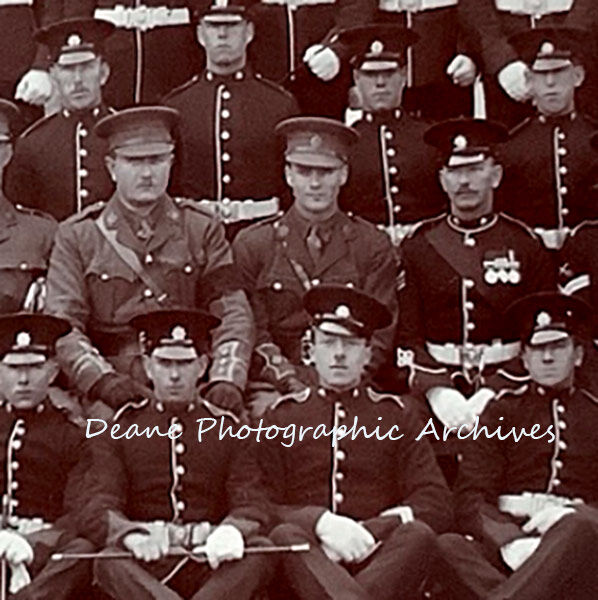
"The black and white photograph is of a tiered group of men, sitting and standing, 64 in total, 3 Officers and 61 assorted ranks, taken outside a solid black and slate tiled building.
The officers are in traditional khaki, wearing a Sam Browne belt, markings are visible on the lower section of the sleeve near the hand indicating a rank (?).
From the sleeve markings it appears that there is a Captain in the centre of the three officers, a Lieutenant on the left and a Second Lieutenant on the right..
The other men are wearing what appears to be a dark blue uniform with five 'silver' buttons down the centre, white belts and white gloves. There are some slight differences in the styling of these uniforms - first seated row, third left, fourth left and eighth left. The men either side of the officers are wearing medals and have a slightly different neckline.
Noticeable differences in appearance are third row, third left and top row, third left.
In the early 1900, British Army Bandsmen wore elaborate highly decorated epaulettes on their full dress tunics.
What appears to be unusual in the photograph is the number of 'wands or conductor batons': I counted at least five! all in the lower front rows.
The lapel and cap badges worn by the officers appear to be be very similar to that of the First Devonshire Regiment.
I think the photo was taken in the early 1900s.
In the early standard battalion bands may have had up 35 members but normally less than that. This image shows 64 in total so maybe there's more than one band shown??
Mt conclusion (and I won't mind being proved incorrect) is that the photograph shows a Regimental band(s) in ceremonial dress with a possible association to the First Devonshire Regiment.
It is understand that members of a band may have other duties as well."
Location: Jersey
Photographer: A Laurens
